Orbis: A Competency-Based Framework for English Studies at Universidad Central "Marta Abreu" de Las Villas
Abstract
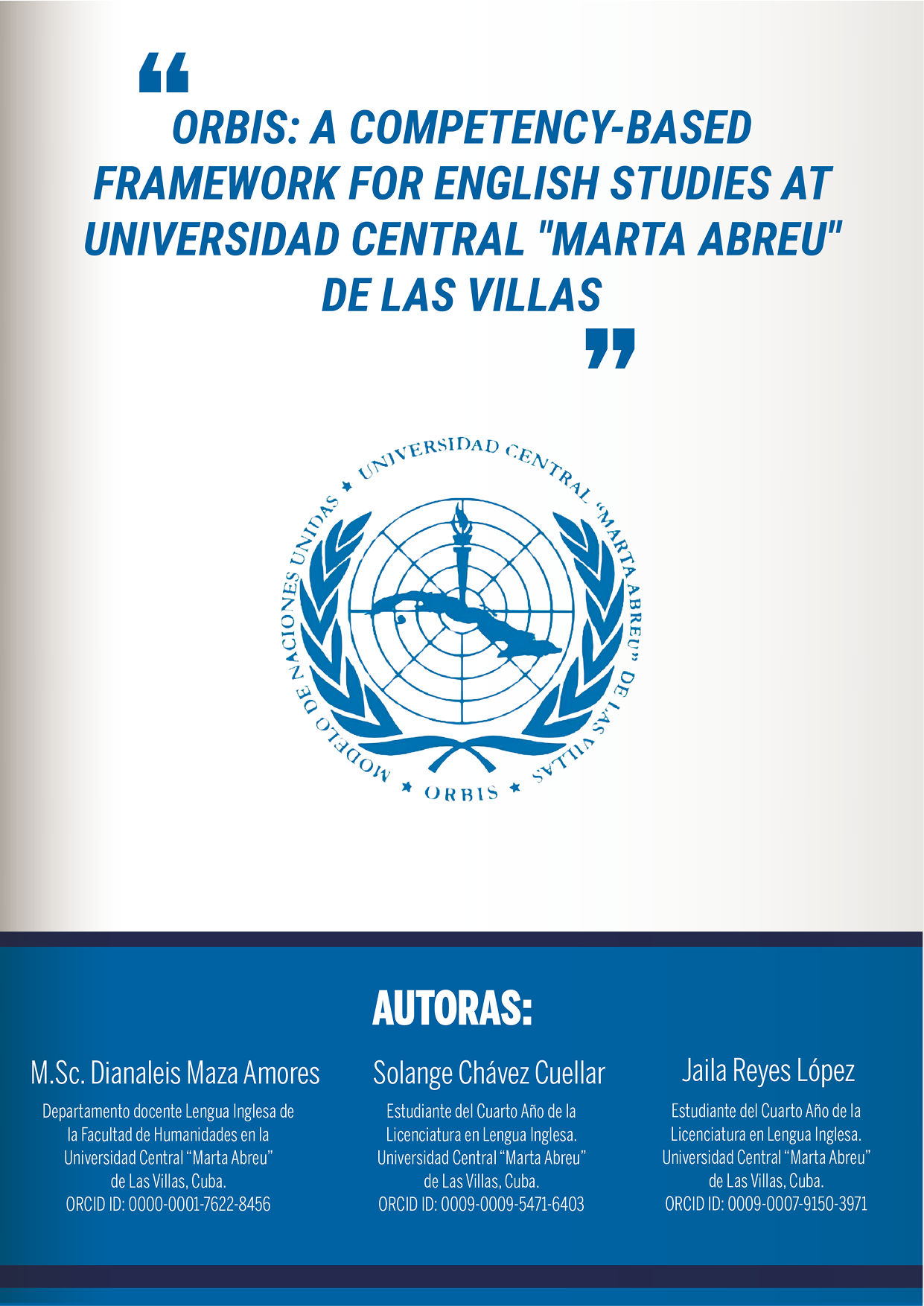
Orbis, which means "world" in Latin, is the name of the United Nations Model of Universidad Central "Marta Abreu" de Las Villas that seeks to engage university students in discussions about major issues on the international agenda. Every year, this university along with the Cuban Association of the United Nations, the Faculty of Social Sciences, and the University Student Federation convene a new edition of Orbis with the purpose of raising a topic of high international complexity. Orbis in itself is a potential competency-based approach, which qualifies students to develop fluency, accuracy, specific vocabulary and confidence to express themselves within a professional context. Likewise, this event challenges students to make decisions, resolve conflicts and find creative solutions in simulated situations. This proposal seeks to empower Orbis so that it accounts as a professional education laboratory where English language students develop professional skills, like public address and management, and the lab where curricular courses come alive and help to sort out professional issues. Through a mixed-methods approach involving document analysis, faculty interviews, and student surveys, the study designs and validates a pedagogical model that systematically incorporates Orbis simulations into the academic program. The findings demonstrate that this integration not only enhances linguistic proficiency but also equips students with the professional readiness required for global careers in diplomacy, tourism, and international relations, thereby setting a benchmark for competency-based language education in Cuba.
Downloads
References
Anuyahong, B and Songakul, K. (2024). Analyzing the Effectiveness of Content-Based Language Teaching (CBLT) Approaches in Integrating Language Learning with Subject Matter Instruction in TEFL Contexts. Int. J. of Adv. Res, 12(07), 109-118.
Barroso Fontanals ME, González Marrero AI. (2025). SASMUS: un hito en la historia de los modelos de naciones y la salud mundial. EsTuSalud, 7(2025):e383. https://revestusalud.sld.cu/index.php/estusalud/article/view/383
Bloom, B. S. (1956). Taxonomy of educational objectives. Vol. 1: Cognitive domain. New York: McKay, 20, 24.
Burgos, D.E. (2023). Naciones Unidas a lo cubano. Revista Alma Mater en Medium. https://medium.com/revista-alma-mater/naciones-unidas-a-lo-cubano-5f325f3e21ed
Candia Osorio, J. J. (2025). Modelos de naciones unidas como simulación educativa: experiencias transformadoras y pensamiento crítico en la formación universitaria. [Tesis de pregrado, Universidad Federal de la Integración Latino-Americana]. Archivo digital. https://dspace.unila.edu.br/server/api/core/bitstreams/7ce91d17-163a-42c2-a
Castiñeira G. M. A. (2018, 25 de enero). Dedicarán a la independencia de Puerto Rico Modelo de Naciones Unidas en Cuba. Cubadebate. http://www.cubadebate.cu/noticias/2018/01/25/dedicaran-a-la-independencia-de-puerto-rico-modelo-de-naciones-unidas-en-cuba/
Dilaram, M. (2025). The Role of Language in Modern Diplomacy. Journal of New Century Innovations, 89 (1), 8-11.
Dorado, J. L. P., & Fontanals, M. E. B. (2024). Los modelos de Naciones Unidas en las universidades cubanas: baluarte para la preparación integral. Panorama Cuba y Salud, 19(1), 20-21.
Erstad, W. (2021). What is Competency –Based Education? A Beginner´s Guide for Students. https://www.rasmussen.edu/student-experience/college-life/what-is-competency-based-education/
Irlina, A., Barni, M., & Basir, A. (2024). Nurturing Resilient Generations: Character Education in Islamic Teachings within the Framework of Society 5.0.
McIntosh, D. (2001). The uses and limits of the model United Nations in an international relations classroom. International Studies Perspectives, 2(3), 269-280.
Niehoff, M. (2020, 20 de febrero). Competency-Based Approaches Focus On Skills, Relevancy and Personalization. Getting Smart. https://www.gettingsmart.com/2020/02/20/competency-based-approaches-focus-on-skills-relevancy-and-personalization/
Richards, J. C. (2005). Communicative language teaching today. Singapore: SEAMEO Regional Language Centre.
Rodríguez B, G. (2024, 23 de junio). Orbis UCLV, un modelo de naciones unidas en el centro de Cuba. Telecubanacán.
Ruhl, Ch. (2025, March 11). Bloom´s Taxonomy of Learning. Simply Psichology. https://www.simplypsychology.org/blooms-taxonomy.html
Toni, P. (2017). Modelo de naciones unidas: una propuesta pedagógica. XVI Jornadas Interescuelas/Departamentos de Historia. Departamento de Historia. Facultad Humanidades. Universidad Nacional de Mar del Plata, Mar del Plata. P. 2 https://www.aacademica.org/000-019/692
Downloads
Published
How to Cite
Issue
Section
License
Copyright (c) 2026 Ad Hoc

This work is licensed under a Creative Commons Attribution-NonCommercial 4.0 International License.